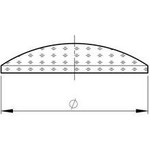
In this category you will find biconvex glass lenses, plano-convex glass lenses and bi-aspherical plastic lenses for installation in your own designs.
Difference Between Biconvex, Plano-Convex and Bi-Aspheric Lenses
The most important lens types used in optical measurement technology differ not only in their shape, but above all in their optical behavior, image quality and specific application range. For users in industry, quality control, metrology, microscopy and optical development, understanding these differences is essential in order to select the optimal lens for a given application.
- Fundamentals of Optical Lenses
Optical lenses are used to focus, bundle or project light rays in a controlled manner. The geometry of the lens surfaces directly influences:
- focal length
- magnification
- image sharpness
- light transmission
- distortion
- optical aberrations
The quality of an optical application therefore depends significantly on the correct lens design.
- Biconvex Lenses
Definition
A biconvex lens has two outwardly curved surfaces.
Optical Properties
- converging lens with positive focal length
- focuses parallel light rays into a focal point
- good light transmission
- symmetrical design
- suitable for many standard applications
Typical Applications
- magnifiers
- projection optics
- simple camera systems
- optical sensors
- illumination systems
- laser systems
Advantages
- high light efficiency
- simple construction
- cost-effective production
- versatile use
Disadvantages
At larger apertures or higher precision requirements, optical aberrations may occur:
- spherical aberration
- edge blur
- distortion
These effects arise because marginal rays are refracted more strongly than central rays.
- Plano-Convex Lenses
Definition
A plano-convex lens has one flat and one convex surface.
Optical Properties
- also a converging lens
- reduces certain optical aberrations
- especially suitable for collimated light
- improved performance with directed light beams
Correct Orientation
Lens orientation is important:
- convex side toward the parallel light source
- flat side toward the focal point
This minimizes spherical aberration.
Typical Applications
- LED optics
- laser technology
- precision sensors
- optical measuring systems
- collimators
Advantages
- better image quality than biconvex lenses
- reduced spherical aberration
- high precision for technical applications
Disadvantages
- asymmetric optical behavior
- more sensitive to incorrect installation
- limited performance in extremely demanding applications
- Bi-Aspheric Lenses
Definition
Bi-aspheric lenses feature specially calculated aspheric surfaces on both sides. These surfaces do not follow a simple spherical geometry.
Technical Characteristics
The curvature changes continuously across the entire surface. This allows light rays to be focused with significantly higher precision.
Purpose of Aspheric Geometry
Correction of optical errors such as:
- spherical aberration
- field curvature
- distortion
- edge blur
Optical Advantages
Bi-aspheric lenses provide:
- extremely high image sharpness
- improved contrast
- higher resolution
- more compact optical systems
- reduced weight
Typical Applications
- precision metrology
- industrial imaging
- high-quality magnification systems
- microscopy
- medical optics
- camera technology
- high-end optical systems
Disadvantages
- significantly more complex manufacturing
- higher production costs
- demanding calculation and quality control
- Comparison of Lens Types
|
Property
|
Biconvex
|
Plano-Convex
|
Bi-Aspheric
|
|
Design
|
convex on both sides
|
one side flat
|
aspheric precision surfaces
|
|
Image Quality
|
good
|
very good
|
excellent
|
|
Optical Aberrations
|
higher
|
reduced
|
strongly minimized
|
|
Manufacturing Complexity
|
low
|
medium
|
very high
|
|
Cost
|
low
|
medium
|
high
|
|
Precision Applications
|
limited
|
good
|
optimal
|
|
Typical Use
|
standard optics
|
technical optics
|
high-end optics
|
- Why Modern Precision Optics Increasingly Use Aspheric Lenses
With increasing requirements in:
- quality control
- industrial metrology
- image processing
- microscopy
- electronics manufacturing
classical spherical lenses are often no longer sufficient.
Bi-aspheric lenses enable:
- higher precision
- improved measurement accuracy
- reduced optical errors
- more compact designs
- superior image quality at high magnification
For this reason, they are increasingly used in professional optical systems.
- Importance in Industrial Metrology
In industrial quality control, the choice of lens directly affects:
- measurement accuracy
- edge sharpness
- contrast
- visibility of smallest details
- reproducibility of measurement results
Especially in precision magnifiers, video microscopes and optical measuring systems, high-quality lens systems are essential for reliable results.
- Summary
Biconvex Lenses
The classical standard solution for simple optical applications with good light transmission and economical production.
Plano-Convex Lenses
Optimized converging lenses for technical applications with reduced optical aberrations.
Bi-Aspheric Lenses
Highly advanced precision optics for maximum image quality, highest accuracy and professional metrology.
Recommendation for Professional Applications
For simple viewing tasks, biconvex or plano-convex lenses are often sufficient.
However, whenever highest precision, minimal distortion and maximum image quality are required, bi-aspheric lenses represent the technically superior solution.