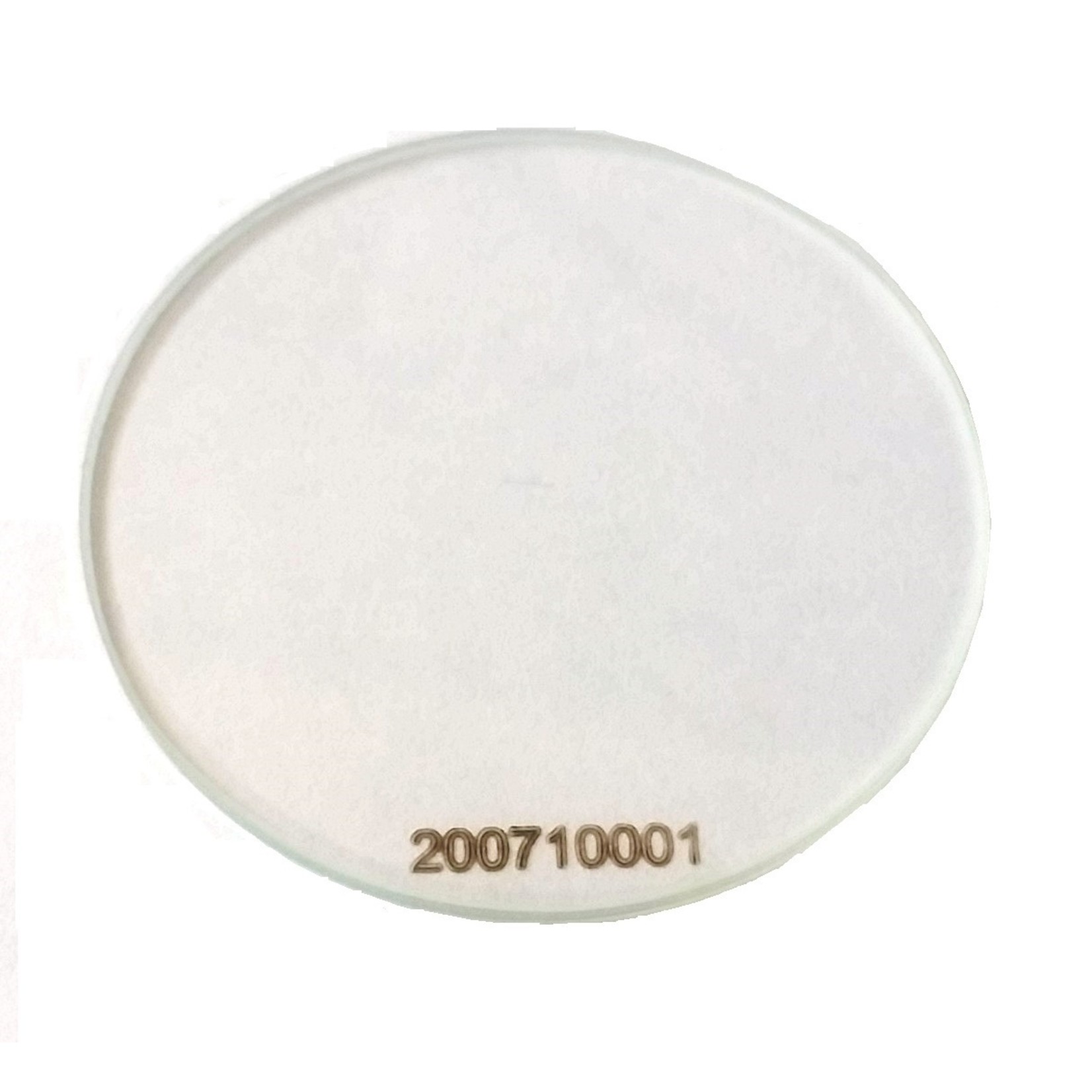
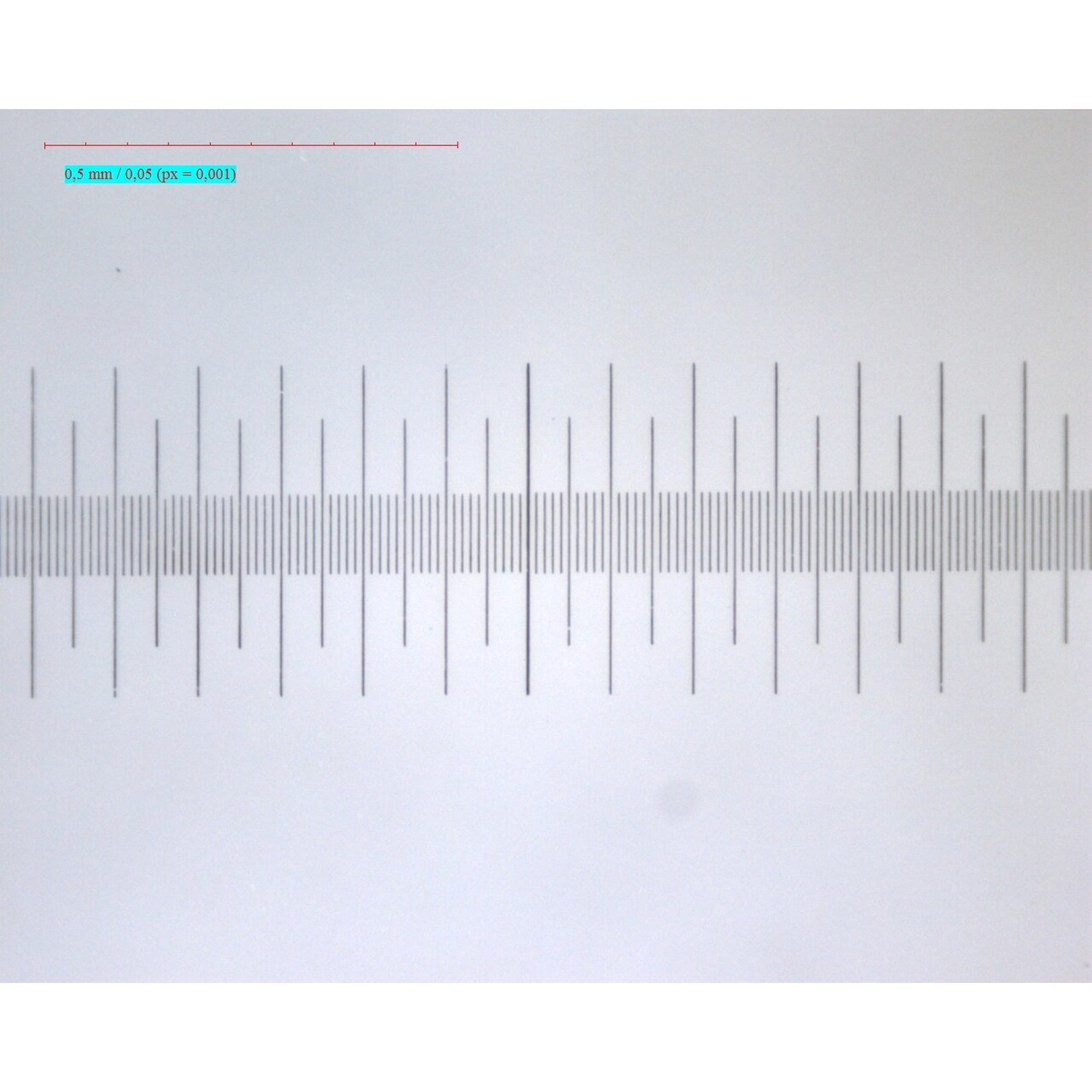
Calibration disc for microscopes – reference standard for checking and recalibrating measuring microscopes
Purpose of a calibration disc for microscopes:
A calibration disc (stage micrometer) is used to check and calibrate measuring microscopes. It serves as a precise reference standard, which can be used to check the measuring accuracy of a microscope and readjust it if necessary.
Calibration discs are used in particular with monocular and binocular measuring microscopes as well as video microscopes with measuring software.
In contrast to classic measuring magnifiers, no direct calibration certificate can be issued for the integrated scale of these microscopes. Instead, metrological verification is performed using an external certified reference object.
Why microscopes cannot be calibrated directly
Difference between measuring magnifiers and measuring microscopes
Measuring magnifiers with an integrated scale – for example, model 1983 – are a physical embodiment of a scale in a 1:1 ratio.
The distance between two scale lines is, for example:
100 µm ± manufacturing tolerance
Since these scales represent a real length, they can be measured directly in a calibration laboratory. The measured deviations are then documented in a calibration certificate or DAkkS certificate with traceability to national standards.
Special feature of the eyepiece scale in the microscope
The situation is fundamentally different for measuring microscopes.
Here, the scale is located in the eyepiece of the microscope and is part of the optical system. This so-called eyepiece scale does not represent a real length measurement on a 1:1 scale.
The effective length of a scale division in the object is only determined by the interaction of several optical parameters:
- Focal length and magnification of the objective lens
- Image of the intermediate image in the tube
- Position of the eyepiece scale in the beam path
- Total magnification of the microscope system
The division of the eyepiece scale therefore only corresponds to a defined real length in the object space (e.g., 10 µm or 20 µm) at the focus of the microscope. The measured length is thus a property of the entire optical system and not exclusively of the scale itself. For this reason, an eyepiece scale cannot be calibrated or certified as a length scale independently of the microscope. Furthermore, dismantling the scale for separate measurement is not intended in the design and would require cleanroom-like conditions due to the necessary cleanliness requirements.
Calibration of microscopes with a certified calibration disc
A certified calibration disc (stage micrometer) is therefore used for the metrologically correct inspection of a microscope. This consists of a high-precision reference scale with known line spacing, for example:
Calibration scale S-1983-001 with 10 µm division
The scale is measured in an accredited calibration laboratory and supplied with a calibration certificate – ideally with DAkkS accreditation.
The following values are determined:
- Actual line spacing
- Measurement deviation
- Measurement uncertainty
- Traceability to national standards
The calibration disc thus serves as a traceable reference test instrument for calibrating microscopes.
Application of the calibration disc
To check the microscope, the calibration disc is positioned on the stage and focused under the microscope.
By comparing
- the scale division of the microscope
- and the certified line spacing of the reference scale
it can be determined whether the microscope is operating within the permissible measurement deviation. For video microscopes or digital measuring systems, the measurement software is also calibrated in this step by storing the known reference distance as a scaling factor in the system.
Documentation of the microscope inspection
The inspection of the microscope is usually documented in an internal calibration protocol or test report.
Typical contents of such a calibration certificate are:
- Designation and type of the tested microscope (e.g., PEAK microscope type 2034-100)
- Measurement points and tested scale distances
- Measured measurement deviations
- Serial number of the reference test equipment (calibration disc)
- Serial number of the tested microscope
- Name of the tester
- Date of inspection
- Ambient conditions (temperature and humidity)
- Reference to the calibration certificate of the reference test equipment
- Date of the next recalibration
A sample of such a calibration certificate can be found at the link below.
Calibration discs for microscopes – available models
If you would like to order a calibration disc to check or calibrate your microscope, we can offer you two different models:
- S-001-S (without DAkkS protocol)
- S-001-S-DAkkS (with DAkkS protocol)
Muster - Sample_S-1983-DAkkS